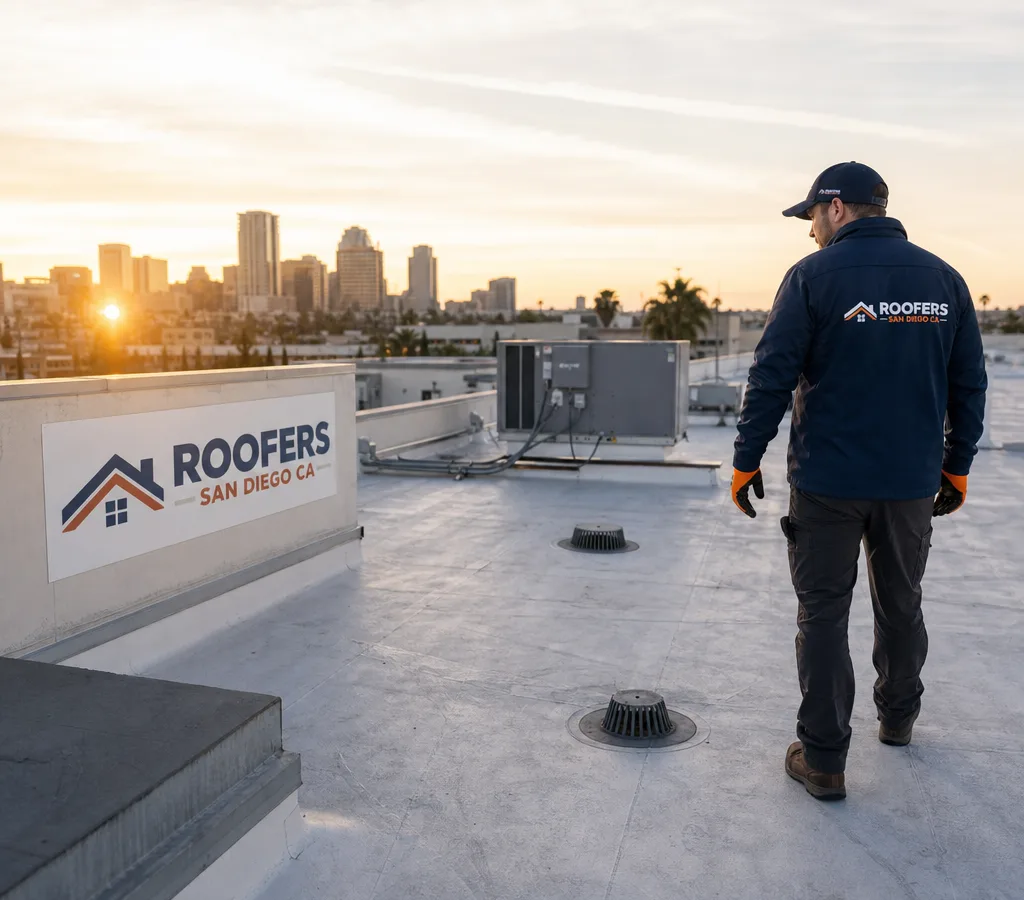
Commercial flat roof in San Diego with HVAC units, roof drains, and a technician performing a sunrise inspection

Inspections, repairs, replacements

San Diego Commercial Roofing

Protect your building, tenants, and equipment with clear inspections, practical repair options, and commercial roof systems built for coastal wear, heat, and wind.

✓Commercial roof inspections ✓Written scopes ✓Low-slope roof expertise ✓Operational planning

Commercial roof planning

Commercial Roof Systems for Businesses That Can't Shut Down

Commercial roofs fail differently than residential roofs. Leaks may show up far from the entry point, ponding water can stress seams, and small penetrations for HVAC and conduit become the weak spots. Our commercial roofing team helps property managers and business owners make decisions that hold up operationally: what can be repaired now, what should be budgeted, and what needs to be replaced before it disrupts tenants or inventory.

San Diego adds its own challenges. Coastal air can speed up corrosion at metal edges and fasteners. UV exposure is intense across open roof areas, which ages membranes and coatings. Winter storms may be sporadic, but when rain hits hard, blocked drains and low-slope details get tested quickly. We focus on the details that usually decide whether a commercial roof stays dry: terminations, flashings, penetrations, drains, and transitions.

Roofers San Diego CA works throughout San Diego, CA. If you manage multiple buildings, we can prioritize the highest-risk areas first and document conditions so you can plan capital work instead of reacting to emergencies.

Call Now (619) 903-6894

Commercial capabilities

What we handle

Leak investigation and targeted repairs

We trace likely water paths, check penetrations and wall transitions, and repair splits, punctures, failing sealant, and open seams. The goal is to stop the leak and reduce the chance of it returning next storm.

Preventive maintenance for low-slope roofs

Routine roof walks catch cracked flashings, loose edge metal, debris at drains, and early membrane wear. Maintenance is usually the lowest-cost way to extend roof life on occupied buildings.

Commercial roof replacement and retrofits

When repairs stack up, we help you compare recover options versus tear-off, coordinate staging, and choose systems that match your building use and local exposure.

Coatings and restoration (when appropriate)

For roofs with sound substrates, restoration may include cleaning, prep, reinforcing details, and applying a coating system. We will tell you plainly when a coating is a fit and when it is not.

Emergency response after wind or rain events

Temporary dry-in, controlled tarp placement, and safety-first access for active leaks. We document conditions so you have a clean path to permanent repair.

Roof penetrations and flashing work

Curbs, pipe boots, vent stacks, skylight bases, and equipment supports are common leak sources. We rebuild and seal these details using manufacturer-appropriate materials and methods.

Call Now (619) 903-6894

Commercial roof systems

Roof systems we commonly service on commercial buildings

Commercial roofing in San Diego often starts with a flat or low-slope roof, but the system type changes how repairs and replacements should be approached. We work with common commercial assemblies and explain tradeoffs in plain terms before work begins.

Typical systems include:

  • Single-ply membranes: TPO and PVC with heat-welded seams, and EPDM adhered or mechanically attached with taped seams.
  • Modified bitumen: Torch-applied or self-adhered sheets, often used where durability and foot traffic matter.
  • Built-up roofing: Layered plies with surfacing, usually found on older buildings.
  • Commercial metal roofing: Standing seam or exposed-fastener assemblies, often over retail or light industrial spaces.

We also look closely at insulation and slope. Poor drainage, crushed insulation, and saturated sections are often the real reason a roof keeps leaking. On many buildings, the fix is not a bigger patch. It is correcting the detail that holds water or moves with temperature swings.

If you are comparing contractors, start by checking whether they are willing to show you photos of the exact problem areas and explain why the proposed repair matches your roof type. If the scope is vague, the outcome usually is too.

Call Now (619) 903-6894
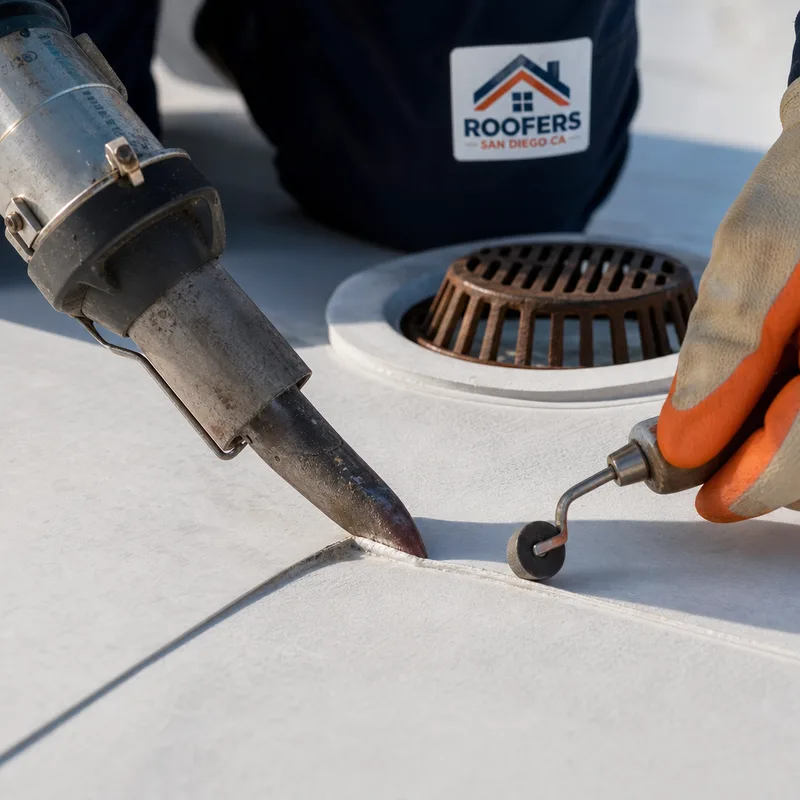
Commercial TPO roof seam being heat-welded and checked beside a low-slope roof drain

Inspection to completion

How a project runs

01

Site walk and safety-first access

We coordinate access with your manager or tenant contact and follow jobsite safety basics for ladders, roof hatches, and walkway paths. We note rooftop units, skylights, parapet conditions, and any active leak locations you have documented.

02

Inspection and moisture-risk review

We check seams, flashings, penetrations, edge metal, scuppers, and drains. On low-slope roofs, we pay extra attention to ponding areas and the condition of the insulation and substrate around them.

03

Written scope with options when it matters

You get a clear scope that matches the roof type and problem. When there is more than one responsible path, we outline options such as repair versus partial replacement, or restoration versus full replacement.

04

Scheduling that respects business operations

We plan staging, material delivery, and work hours to reduce disruption. For occupied properties, we coordinate noise, access routes, and any areas that need protection below active work.

05

Completion photos and maintenance recommendations

We document key repairs and finished details. If we see issues that can be handled with routine maintenance, we spell them out so you can prevent repeat leaks and avoid emergency calls.

Call Now (619) 903-6894

Planning your project

What commercial roof work costs

Commercial roofing typically runs about $7 to $14 per square foot for replacement on many low-slope systems, while smaller repairs often start around $450 to $2,500 depending on access and complexity. Restoration coatings may fall around $3 to $7 per square foot when the roof is a good candidate.

Your price changes most with roof size, membrane type, tear-off needs, insulation condition, number of penetrations and curbs, edge metal, drainage corrections, and how easy it is to stage materials. The exact cost is confirmed after an on-site inspection and a written scope tailored to your building.

Call Now (619) 903-6894

Local roof conditions

Local factors that affect your roof

The area's mix of coastal and inland microclimates shows up on rooftops. Near the coast, salt air can accelerate corrosion on exposed fasteners, HVAC stands, and metal coping. Inland heat and strong sun can age exposed surfaces faster, which is why surface preparation and manufacturer-approved details matter for any repair, coating, or membrane work.

Building layout matters too. Areas like Downtown and the Gaslamp Quarter often involve tighter access, shared loading zones, and rooftop equipment packed into small footprints. Hillcrest and Mission Hills include older commercial structures where you may find mixed roof assemblies, multiple layers, or long-running repairs that need a more careful plan. In Kearny Mesa and Miramar, larger warehouse-style buildings can have long drainage runs and wide open spans where slope and drain maintenance make a big difference during heavy rain.

No matter the neighborhood, the fastest way to reduce risk is simple: keep drains and scuppers clear, address flashing failures early, and avoid stacking patch on patch without fixing the underlying movement or ponding that causes repeat leaks.

If you are still narrowing down who to hire, start with a contractor that can explain their approach clearly and show examples of commercial work; our roofing team can walk the roof with you and recommend next steps based on what is actually there.

Call Now (619) 903-6894
Common questions

Questions from property managers

How quickly can you respond to a commercial roof leak?

For active leaks, we prioritize quick scheduling to stop water intrusion and protect interiors, then return with a permanent repair plan if conditions require it. Timing depends on access permissions, roof height, and weather, but the first goal is controlled dry-in and documentation of the likely entry points around penetrations, drains, or wall transitions.

Can you repair a flat roof, or does it usually need replacement?

Many flat and low-slope roofs can be repaired when the membrane and substrate are still sound and the issue is localized at seams, flashings, or penetrations. Replacement becomes more likely when moisture is widespread, insulation is saturated, the roof has repeated leaks in multiple areas, or prior repairs have created an uneven surface that traps water.

What are the most common leak sources on commercial roofs?

The most common leak sources are penetrations such as HVAC curbs, pipes, and conduit; failed flashing at parapet and wall transitions; open seams on single-ply membranes; and clogged drains that cause ponding water. In the area's sun, sealants and exposed materials can age faster, so small cracks around details should be addressed early.

Do you offer maintenance plans for commercial roofing?

Yes, maintenance is available and is often the best fit for multi-tenant or mission-critical buildings where avoiding surprise leaks matters. A typical plan includes scheduled roof walks, drain and scupper checks, photo documentation of changes, and prioritized repair recommendations before the rainy season.

Can a new commercial roof be installed over an existing roof (a recover)?

Sometimes, yes, a recover can work when the existing roof is dry, stable, and allowed by code and manufacturer requirements, but it is not always the right move. We evaluate trapped moisture risk, attachment, insulation condition, edge details, and drainage; if the underlying system is compromised, a tear-off is usually the safer long-term option.

How do you minimize disruption for tenants and employees during commercial roof work?

We plan staging and work zones, coordinate access times, and keep walk paths clear around roof hatches and ladders. For occupied buildings, we also flag any noisy steps, protect sensitive areas below work zones, and coordinate around rooftop HVAC servicing so the building can keep operating.

Schedule a roof walk

Get a clear plan for your commercial roof

Share what you are seeing (leaks, ponding, aging membrane, tenant complaints) and we will schedule a roof walk, document the problem areas, and provide a written scope you can act on.

Call Now (619) 903-6894